
.png)


Bad Bunny Reimagined the American Stage at Super Bowl LX
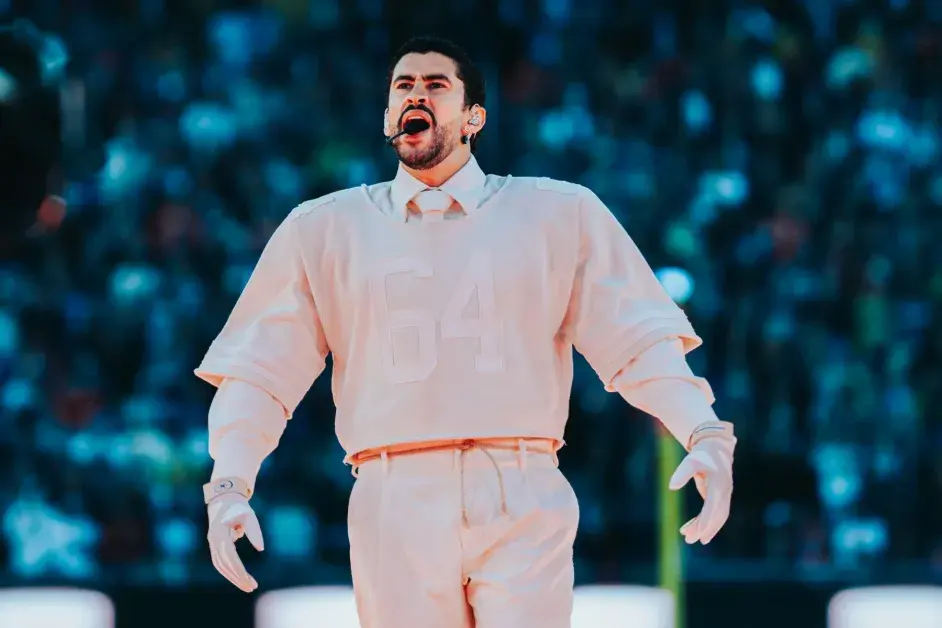
For decades, the Super Bowl halftime show has functioned as the ultimate American ritual. We’ve seen the legacy rock performances of the 2000s, the high energy pop of the 2010s like Lady Gaga and Katy Perry, and the hip-hop performances of the 2020s; think of Snoop Dog, 50 cents, Kendrick Lamar, and much more. But on Sunday night at Levi’s Stadium, Benito Antonio Martínez Ocasio, known to the world as Bad Bunny, didn’t just perform for America; he invited America to Puerto Rico.
In a spectacular 13-minute set that felt more like a festival than a performance itself, Bad Bunny proved why he is the most vital and popular artist of the current era in a world of uncertainty and conflict. It embodied what it means to be American; proud, patriotic Americans.
The production opened with a lush sugar cane field, coconut vendors, and piraguas “which are snow cone” carts. As he kicked into the beat of “Tití Me Preguntó,” the stadium felt exactly what it was meant to be; a normal day in Puerto Rico amongst a crowd of 70,000 people in San Francisco in addition to the 128 million people watching from their homes, turning this into a community gathering that 128 million people were lucky enough to witness.
The most remarkable feat, in my opinionof the night was the language. In a historic first, a performance was performed a set almost entirely in Spanish. In a climate that was marked before the show by political tension and "ICE-out" rhetoric, Benito’s refusal to "translate" himself was his most radical act, and he did it in a respectful manner, bringing out a powerful message as the central theme of the performance: “The Only Thing More Powerful than Hate Is Love”.
When the lights dimmed, the pulsing rhythm of “El Apagón,” and performers swung from power lines in a nod to the island’s energy crisis, the message was clear: joy and resistance are two ways to live life yet make a difference. He didn’t need a political speech; the presence of the blue-and-white Puerto Rican independence flag, and the other Latin American flags, across the 50-yard line said everything.
The most remarkable thing about the concert was, and get this: There was an official licensed wedding! The specifics of the guest list were handled with ease, as it was a lot of people attending the wedding. While many headliners use guests to sing or illuminate the lights on their phone, Benito used them as a celebration of his own culture. In a move that felt like a fever dream between art and life, a real couple (Eleisa Aparicio and Thomas Wolter) was married on stage during the set. Think of it as a "first dance" for the world to see.
Now, for the superstars part of the show. Ricky Martin’s appearance to perform “Lo Que Le Pasó a Hawaii” was a passing of the torch, a nod to the 90s Latin explosion that paved the way for this moment, maintaining the key idea that Puerto Rico is sovereign and has their own culture that should never be stripped from them. Additionally, Lady Gaga’s appearance was the night’s most clever way to gauge the “American” Audience. They performed a "salsafied" version of “Die With a Smile,” merging her pop style with his Caribbean roots in a way that felt entirely organic and natural, to the point where Bad Bunny and Lady Gaga shared a meaningful and impactful dance.
In conclusion, the show closed with the high-energy “DTMF” (from his Album of the Year Grammy winner, DeBÍ TiRAR MáS FOToS), as Benito led a “parranda” of dancers, boxers, and legends like Cardi B and Karol G and Ronald Acuña Jr. across the field, alongside a barrage of people that ran alongside him with flags of all different latino nationalities, showing a cultural representation of what it means to be American and united.
We often judge these shows by their "viral moments," but Bad Bunny’s performance will be remembered for its soul, and especially its passion. He didn't try to fit into the Super Bowl by listening to the outside noise; he made the Super Bowl fit into his world, into what he lived through and grew up to be. It was a masterclass in authenticity, proving that in 2026, the most "American" thing you can be is yourself, unfiltered, unapologetic, and in your own language.


Comments