
.png)


A Night of Records and Rebellion: The 68th Grammy Awards
Updated: Feb 27
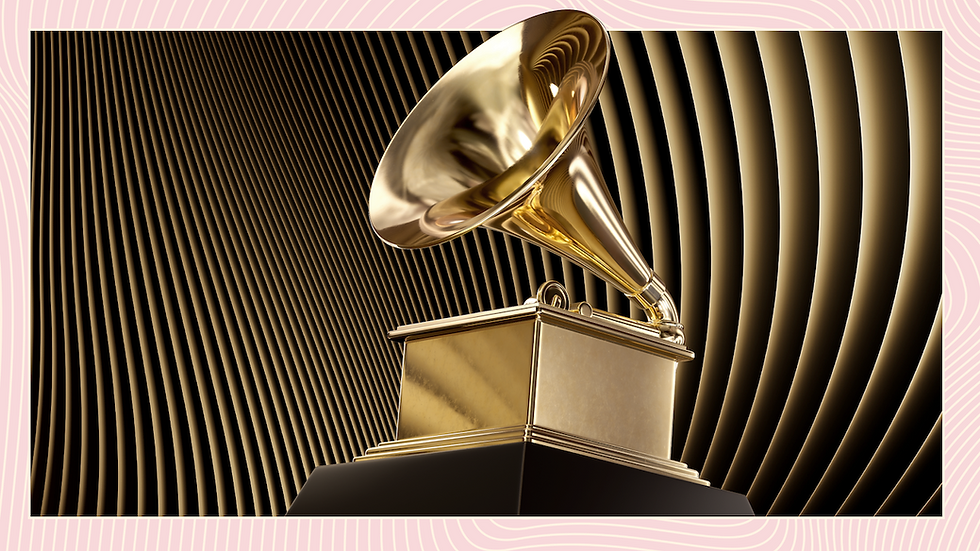
The Grammy Awards are the music industry's most prestigious honors. Presented annually by The Recording Academy since 1959, it recognizes outstanding achievements in various genres through peer-voted awards, with artists and producers selecting the winners. It is known as “music's biggest night”, celebrating excellence in songwriting, recording, and producing.
The 2026 Grammys took place on February 1st in Los Angeles, California. Featuring a total of 95 categories, some of the most esteemed include: “Album of the Year”, “Record of the Year”, “Song of the Year”, and “Best New Artist”. Winners receive a gilded gramophone statuette, which inspired the Grammys’ original name, the “Gramophone Awards”. The Grammys are considered one of the four major annual American entertainment awards alongside the Academy Awards (for films), the Emmy Awards (for television), and the Tony Awards (for theater). The first Grammy ceremony was held on May 4th, 1959, and honored the musical accomplishments of performers from 1958.
The 4 notable winners of the 68th Grammy Awards were: Bad Bunny (Debí Tirar Más Fotos) for Album of the Year, Kendrick Lamar (Luther) for Record of the Year, Billie Eilish (Wildflower) for Song of the Year, and Olivia Dean for Best New Artist.
Highlights include Kendrick Lamar winning 5 awards, making him the most awarded hip-hop artist in Grammy history, and Bad Bunny made history by becoming the first artist to win Album of the Year for a fully Spanish-language album. There was also Lady Gaga’s continued success in her record-breaking career in the pop category. While most of the winning artists were predictable, some surprises still occurred. Notably, Lola Young winning Best Pop Solo Performance was a surprise, as she herself had not even prepared a speech, making it an emotional and memorable moment. Trevor Noah also returned for the 68th Grammys, marking his sixth consecutive time hosting the ceremony. The last surprise was the fact that this year marks the final time the Awards will air on CBS after 50 years, before moving to ABC and Disney+.
Fashion at the Grammy Awards is central to the event’s identity, as it allows musical artists to express their brand and musical persona, serving as a high-stakes spectacle while making bold cultural statements. The Grammys are characterized by daring, theatrical fashion that blends into pop culture; it’s what makes the Grammys the Grammys. Key aspects of why fashion is crucial include being used as an extension of musical artistry and as social or cultural commentary. During this year's Grammy Awards, fashion and political statements blended. This was seen in the “ICE OUT” pins worn by multiple artists like Billie Eilish, Justin & Hailey Bieber, and many more. Grammys fashion is also used to shift gender norms. It has helped men move beyond traditional tuxedos and experiment with bold, avant-garde menswear. The red carpet fashion is often seen as the highlight of the night, generating significant media attention, defining the Grammys as much as the awards themselves.
Not only did the attendees’ fashion choices show activism, but artists also used their speeches to speak out. Notably, Puerto Rican rapper Bad Bunny’s acceptance speech gained attention for encouraging people to love in these hateful times. He stated, “We’re not savage, we’re not animals, we’re not aliens. We are humans, and we are Americans.” This message is especially powerful currently, as manyAmericans do not feel safe in their own country. Additional advocacy was seen in Billie Eilish’s acceptance speech, where she said, “No one is illegal on stolen land.” Trevor Noah, hosting the Grammys for his 6th time, poked fun at Trump, making jokes about Nicki Minaj’s new friendship, Trump's actions towards Greenland, term limits, and more. There was also subtle activism from Olivia Dean, who stated that she is “a granddaughter of an immigrant” and thus, “a product of bravery, and I believe those people deserve to be celebrated.” Overall, this year, the Grammys were a platform for celebrities to protest and advocate for immigrant rights and justice.
Beyond advocacy, this year’s Grammys demonstrated meaningful steps towards diversity in the music industry. Bad Bunny’s album became the first record entirely sung in Spanish to win Album of the Year. Kendrick Lamar, who now has a total of 27 Grammys, won 5 Grammys this year, surpassing Jay Z as the most decorated rapper. Lamar also paid tribute to Luther Vandross, a closeted queer artist who passed away in 2005, whose song Kendrick samples in his Grammy-winning song Luther. Additionally, the Grammys saw the youngest-ever Grammy Award winner, Aura V, age 8, who won the Best Children’s Music Album with her father, Fyütch. Finally, Olivia Dean, a British artist with Jamaican-Guyanese and English heritage, continued the nine-year streak of the Best New Artist Award going to female musicians. She also highlighted support for immigrants while honoring her Guyanese grandmother, who emigrated to the UK as part of the Windrush generation.
Overall, the 68th Grammy Awards lived up to their nickname of “music’s biggest night”, with stunning performances, bold fashion, pioneering artists, and strong activism. The Grammys have become an identity to music in America, but they have also expanded into fashion and advocacy. This ceremony highlighted both musical accomplishments and the tangible expansion of diversity. So, as the music industry continues to evolve, we should look forward to the Grammys evolving alongside it, providing artists with a creative outlet in music, fashion, and activism.


Comments